
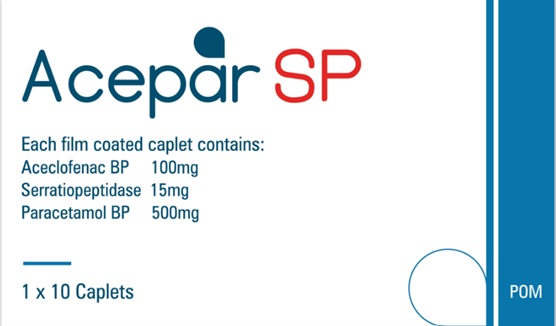
Acepar-SP Caplets
Therapeutic Area: NSAIDs Generic Name: Aceclofenac + Paracetamol + Serratiopeptidase Available as: 100 + 500 + 15mg

Description
Therapeutic Area: NSAIDs Generic Name: Aceclofenac + Paracetamol + Serratiopeptidase Available as: 100 + 500 + 15mg – Prescribing information:
Composition:
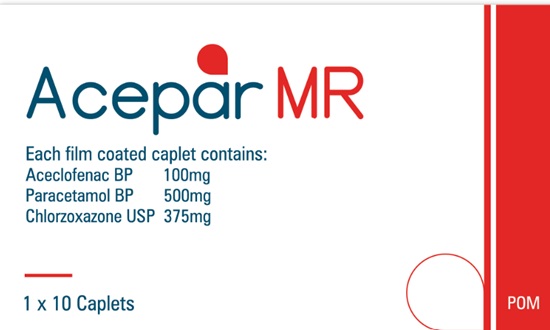
Each film coated caplet contains:
Aceclofenac B.P 100mg.
Paracetamol B.P 500mg.
Serratiopeptidase 15mg.
Pharmacology:
Aceclofenac relieves pain and inflammation through a variety of mechanisms and in addition exerts stimulatory effects on cartilage matrix synthesis.
It inhibits various mediators of pain and inflammation. Aceclofenac stimulates glycosaminoglycan synthesis in human osteoarthritic cartilage by inhibition of IL 1Beta and suppresses cartilage degeneration by inhibiting IL 1Beta mediated promatrix metalloproteinase production and proteoglycan release.
Paracetamol is useful in providing background and analgesia along other analgesic drugs. The exact mechanism of action of paracetamol is unclear, but its analgesic action is thought to be due to inhibition of prostaglandin synthesis. Its antipyretic property can be added benefit.
Serratiopeptidase is a proteolytic enzyme isolated from the micro-organism Serratia E15. It binds to alpha-2-macroglobulin in the blood in the ratio of 1:1, which helps to mask its antigenicity but retain its enzymatic activity. Levels of serratiopeptidase are slowly transferred to the exudate at the site of inflammation and gradually the blood level decline. By hydrolysing bradykinin, histamine and serotonin, it indirectly reduces dilatation of blood capillaries and controls permeability. Serratiopeptidase blocks plasmin inhibitors thus helping the fibrinolytic activity of plasmin. Degradation of ` extra-fibrin` to small fragment prevents clogging of microcapillaries, helps clearance of exudates, reduces swelling and improves microcirculation.
Pharmacokinetics:
Aceclofenac is well absorbed from gastrointestinal tract and peak plasma concentrations (Cmax) are reached 1-3 hours after an oral dose.
The drug is more than 99% bound to plasma proteins and the volume of distribution (Vd) is approximately 25 litres. The presence of food reduced rate of absorption (increased tmax) but not the extent of absorption (Cmax or AUC). In patients with knee pain and synovial fluid effusion, the plasma concentration of Aceclofenac was twice that in synovial fluid after multiple doses of the drug. Aceclofenac is metabolized mainly to 4′ hydroxy-aceclofenac. The drug is eliminated primarily through renal excretion with 70-80% of administered dose found in urine as glucoronides and rest being excreted in faeces. The plasma elimination half life of Aceclofenac is approximately 4 hours.
Paracetamol is rapidly and almost completely absorbed from gastrointestinal tract with peak plasma concentrations (Cmax) occurring about 10 to 60 minutes after oral administration. Plasma
protein binding is negligible at usual therapeutic concentration but increases with increasing concentrations.
Paracetamol is relatively uniformly distributed throughout most body fluids. The plasma half life (t1/2) 2-3 hours and the effect after oral dose lasts for 3-5 hours. Paracetamol is metabolized predominantly in liver and excreted in the urine mainly as glucuronide and sulfate conjugate. Less than 5% is excreted unchanged.
Serratiopeptidase is absorbed through intestines into the blood stream. The oral bioavailability is generally low, owing to the acidic conditions of the stomach
and poor permeability across intestinal mucosa. Enteric coated form enables the enzyme to pass through the stomach unchanged, and be absorbed in the intestine. Serratiopeptidase reduces capillary permeability induced by histamine, bradykinin and serotonin;breaks down abnormal exudates and proteins; facilitates the absorption of decomposed products through blood and lymphatics. Serratiopeptidase has been shown to be absorbed from the digestive tract.
On oral administration, it is absorbed unchanged into the systemic circulation, from where it penetrates into all the tissues. It reaches higher concentrations in the inflamed tissues. It attains peak levels in one hour.
Indications:
ACEPAR – SP caplets is indicated in musculoskeletal and joint disorders such as rheumatoid arthritis, osteoarthritis and ankylosing spondylitis; periarticular disorders like bursitis and tendonitis; soft tissue disorders such as sprains and strains; and other painful conditions like renal colic, acute gout, dysmenorrheal, migraine, post operative oedema; inflammation and oedema associated with trauma, infection, respiratory tract congestion, chronic venous insufficiency; actinic keratoses and fever.
Dosage & Administration:
Adults: The usual dose of ACEPAR -SP is one caplet twice daily by mouth. One caplet in the morning and one in the evening.
Warnings and precautions for use:
ACEPAR SP should be administered with caution and under strict medical supervision in patients with a gastrointestinal illness and in case of a history of peptic ulcer, hemorrhage cerebro-vascular, ulcerative colitis, Crohn’s disease, systemic lupus erythematosus, porphyria, coagulation disorders or of the Hematopoiesis. The acéclofénac should be administered with caution in patients with impaired light to moderate in the function of liver, kidney or heart failure, and in patients predisposed to the fluid retention.during prolonged treatments by NSAIDS, it is recommended to check the hepatic functions, renal and hematologic.
Contraindications:
Should not be administered to patients hypersensitive to aceclofenac or paracetamol other NSAIDs, or patients with a history of aspirin or NSAID related allergic or anaphylactic reactions or with peptic ulcers or GI bleeding, moderate or severe renal impairment.
Side Effects:
Nausea, allergic reactions, skin rashes, acute renal tubular necrosis, diarrhoea, headache, vertigo, dizziness, nervousness, tinnitus, depression, drowsiness, insomnia, fever, angioedema, bronchospasm, rashes and blood dyscrasias.
Drug interactions:
Aceclofenac may increase the plasma concentrations of lithium & digoxin. Concomitant use of aceclofenac & diuretics may inhibit the activity of diuretics.
The activity of anticoagulants may be enhanced when used concomitantly with aceclofenac. Absorption of paracetamol may be reduced by pethidine & propantheline. Serratiopeptidase might decrease blood clotting. Therefore, taking serratiopeptidase along with medications that also slow clotting might increase the chances of bruising and bleeding.
Some medications that slow blood clotting include aspirin, clopidogrel, diclofenac, ibuprofen, naproxen, dalteparin, enoxaparin, heparin and warfarin.
Pregnancy and lactation:
Aceclofenac is contraindicated during pregnancy and breastfeeding hence the combination cannot be used.
Effect in machinery operations:
In case of dizziness or other adverse effects of the central nervous system due to use of the NSIDs, refrain from driving a vehicle or operation of a machine.
Overdosage:
Management of acute poisoning with NSAIDs essentially consists of supportive and symptomatics measures.
Shelf life:
3 years from the date of manufacture. Distribution Category: POM Presentation:
Blister pack of 1 x 10`s per unit box.
Storage conditions:
Store below 30°C. Protect from direct sunlight. Keep all medicines out of reach of children.

Reviews
There are no reviews yet.